
Dodai: Inside Ethiopia’s Shift to E2W
🌎 Issue #98

It’s Tuesday, and today we’re diving into Dodai, an Ethiopian company in the electric two-wheeler (E2W) space. Founded in 2022 by Yuma Sasaki, the company just completed a $13 million round, made up of $8 million in equity and $5 million in debt, from Value Chain Innovation Fund, IPC, Nagase, Persistent ACV Fund, For Seasons, CBC, ICJ, and BII.
The Context
I wasn’t planning on writing another motorbike electrification story for a while. At the end of the day, the impetus to invest in transportation electrification is mostly the same in every developing country: fuel is expensive and dirty, many countries in the region have access to cheap renewables, and electric vehicles are where the puck is going.
And don’t get me wrong, all of that is true in Ethiopia’s case, and I will touch on that in a minute. But that’s not what pushed me to write this article.
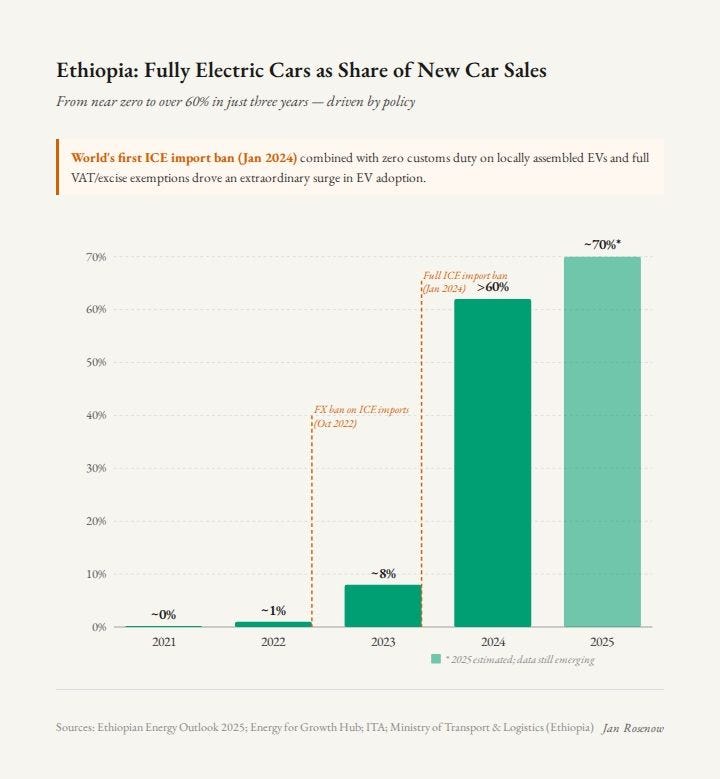
What did is the chart below. Yes, you’ve read the chart correctly: 60% of new vehicles sold in Ethiopia are EVs. This figure was reported by Ethiopia’s Ministry of Water and Energy, so I doubt we can get a more reliable data source than that. If the 2025 projections were correct, that would mean there are just two countries in the world with a higher share: Norway and, surprisingly, Nepal.
Now, in absolute terms, the sales numbers might not sound that impressive. In Addis Ababa, where 95% of the country’s cars are registered, there were 14,000 electric cars on the road. Still, the shift toward electrifying the fleet has been rapid, to say the least.
How did it happen?
Well, fuel in Ethiopia has been subsidized, with the country spending $1.5 billion on fuel subsidies, equivalent to around 10% of the federal budget. When petroleum prices surged in February 2022, that put additional strain on the government’s finances, which pushed it to rethink the country’s petroleum dependency. The government also decided to reduce subsidies, which pushed domestic fuel prices up.
In 2024, it announced a ban on imports of gasoline and diesel vehicles, becoming the first country in the world to do so. At the same time, to stimulate EV adoption, the government made EVs VAT-free and excise tax-free, while also reducing import taxes. The taxes that still applied to EVs were significantly lower than those levied on vehicles with combustion engines, even before the 2024 ban.
To a degree, what allows the country to make this radical EV shift is hydropower, which provides 96% of the country’s electricity. I say “to a degree” because half of the population still doesn’t have electricity access. The Grand Ethiopian Renaissance Dam should help with that. It has been under construction for 14 years, but finally opened last year. It is the largest hydropower plant in Africa and ranks among the top 20 in the world.
Up to this point, we have focused on cars. But a country with a population of 135.9 million has just 250,000 cars. The total number of vehicles is also low, at 1.4 million. That includes buses, motorbikes, vans, and other vehicle types. In other words, there is roughly one vehicle per 100 people. To put that into perspective, in the US, the ratio is closer to 1:1.
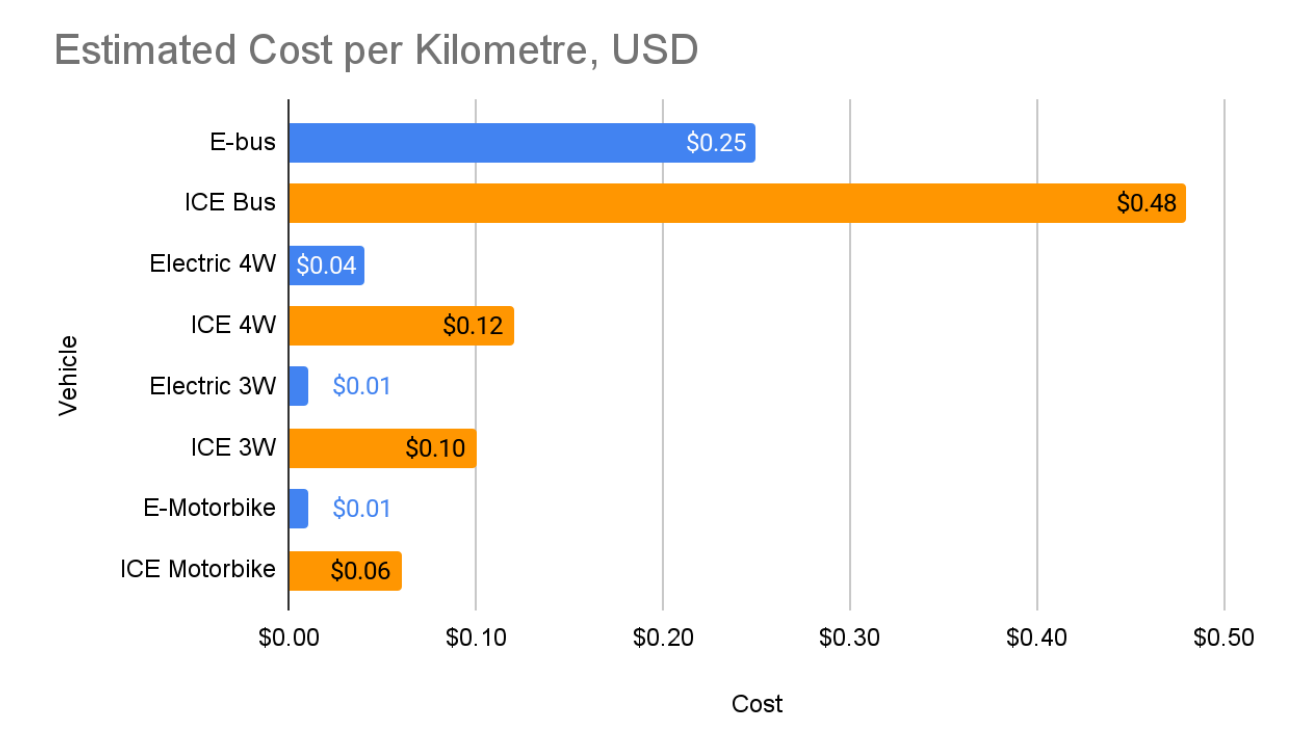
The main reason is cost. Ethiopia is among the poorest nations in the world, with all the associated consequences you might expect. Among those consequences is inadequate public transportation. Commuters can wait for an hour for a bus to arrive, the vehicles themselves are unreliable, spare parts are scarce, and because the road system is inefficient, congestion is a serious issue.
What’s cheaper than a car, but more reliable than public transportation, is a motorbike. We don’t have concrete data on the number of two-wheelers and three-wheelers in Ethiopia, but estimates put the figure between around 250,000 and around 460,000. You would expect that number to be higher, but the government’s relationship with motorbikes has been rocky, especially in Addis Ababa:
In 2019, the city banned the personal use of motorcycles, citing assaults, robberies, and other crimes allegedly committed using motorcycles.
In 2019, the city was already discussing GPS as a condition for motorcycle use, and in 2024, it became mandatoryto have a GPS system installed on your motorbike.
In 2022, it banned motorcycles from carrying passengers, this time citing rider safety concerns.
Even electric motorbikes faced challenges. In 2023 a requirement was introduced for all e-bikes with speeds above 20 km/h to be registered. The problem was that e-bike registration was practically blocked since, according to the government, there was no legal framework for those vehicles.
That changed in 2024, when the city moved to license only electric motorcycles. Meanwhile, the national government introduced the E-Mobility Strategy 2025-2030 for scaling electric transport, with a focus on building charging infrastructure, financing systems, and local EV production capacity. The plan includes full electrification of new two- and three-wheelers by 2030, as well as the setup of 2,200 charging stations nationwide.
That’s where Dodai comes in.
The Product
Dodai is an electric two-wheeler brand. It’s not the first African E2W company, but its positioning is meaningfully different.
Most companies in the region are targeting the low-end market, since that’s where the largest pool of consumers is. Dodai went a different route. It made a commitment to quality, and that pushed the price up. The difference is significant: Dodai’s bikes sell for $1,800, while most competitors are priced about $500 lower.
The main cost driver, as is the case with most E2Ws, is the battery. According to the founder, most players choose lead-acid batteries to keep prices down, while Dodai chose higher-quality lithium-ion batteries. Lead-acid batteries are cheaper, but the company believes they are less reliable, which can leave customers needing a new bike within a year. Sasaki compares Dodai to Toyota in that sense: not the cheapest brand, but a better value over the long term.
Another difference between Dodai and its competitors, at least in the beginning, was its focus on fixed-battery models. Dodai offers two of those:
The HS Lite is positioned for daily commutes and short trips. It has a 120 km peak range, 150 kg carry load, and 50 km/h top speed.
The HS is the higher-range fixed-battery version, with a 150 km peak range, 150 kg carry load, and 50 km/h top speed.
But in 2025, the company unlocked a new product category by introducing a bike with a swappable battery. The TS-1 is the most capable model of the three, with a 200 kg carry load and 70 km/h top speed, although it has a lower range of 100 km.
By offering two model categories, the company creates natural segmentation. Fixed-battery versions are targeted at individuals who have more spending power, want higher range, and have a place to charge their bikes. Swappable-battery versions are better suited to delivery drivers, who spend the whole day on the bike and are more price-sensitive.
The value Dodai provides doesn’t stop with the bikes, however. It also provides operational support around licensing. Dodai partnered with Beatrix, an authorized GPS provider, to help install required tracking systems and subsidize license-plate costs. That reduced the registration timeline from six months to two.
The final nugget on the product side is the story behind spare parts. At first, Dodai’s license allowed it to import raw materials, assemble bikes, and sell the end product. Spare parts, however, were treated as finished goods, so the company was not allowed to import and sell them under that license. Yet customers still needed spare parts. So even though Dodai could not legally sell them, the company imported parts and gave them out for free at the workshop during the first year to build trust.
The Business Model
Two factors dictate how Dodai operates.
The first is the regulatory environment. Dodai imports parts and assembles the bikes in Addis Ababa. In a way, the company was pushed into assembly because Yuma, as a foreigner, couldn’t be the founder of a retail business, even if all he wanted to do was open a cafe. Local manufacturing, however, gave him a path to establish the business. And that’s what he did. Another reason to assemble locally is cost: importing parts is cheaper than importing finished goods because tariffs on the former are lower.
The second is customer segmentation. The two broad segments, as mentioned, are those buying a rechargeable bike and those opting for the swappable-battery version. Here I would say there are three broad consequences of targeting these segments:
Establishing direct sales. This applies to both segments. The market is still at a nascent stage, so Dodai needs to build trust with the buyer. That’s why the company offered spare parts for free, and that’s why it still doesn’t use distributors, instead selling through its own showrooms. Because the market isn’t yet that large, Dodai can afford to keep that direct relationship with customers.
Offering several ways to purchase. The company is quality-focused, which pushes prices higher. Many buyers can’t afford to buy the bike outright, so Dodai needed to offer financing, which it eventually did.
Vertically integrating around batteries. To support the swapping part of the business, the company is planning to open 30 battery-swapping stations across the capital. The next step will be assembling battery packs locally, which would further reduce costs for the buyer.
As with most vertically integrated companies, Dodai has several revenue streams, with direct sales and swapping fees being the main ones.
Results
The company started selling its bikes in the second half of 2023, and by the beginning of 2025, it had sold 850 vehicles. One year later, it was at 1,500.
The Bear Case
The infrastructure for Dodai’s non-swappable models is still lacking. So not only are those bikes more expensive, but their addressable market is also constrained by inadequate charging infrastructure. If the company continues to invest in these models, but demand for whatever reason doesn’t catch up, that could create real pressure on the business.
Another point of concern is Dodai’s aggressive plan to do many things at once. Yes, it has raised enough money to start executing bigger and more ambitious plans. However, overextending itself could put strain on both the team and the capital base.
If we tie the two points together, Ethiopia’s aggressive EV policy can clearly boost growth, but Dodai may still run out of money before the market is truly ready.
The Bull Case
But it might also be the case that in the next few years we’ll see a true boom in E2W demand in Ethiopia. Dodai, being the biggest player, is well positioned to take advantage of that. It has the capital to scale, several offerings that allow it to adapt to market demand, and at least some brand capital to defend itself against newcomers.
Additionally, as it continues to bring assembly, swapping infrastructure, showrooms, and after-sales support under one roof, it may end up with some pricing power and improved margins against its competitors. We are still a long way from that, but there is already demand at the higher end of the pricing spectrum. If the company can prove, at a larger scale than today, that its product is really worth the asking price, it may be able to squeeze additional margin from the market.
The Takeaway
What’s the one lesson investors and founders can take away from Dodai?
Look at early market signals. While there was some luck involved, and Dodai couldn’t have predicted the exact shift to EVs, the underlying fundamentals were already there: cheap electricity, fuel subsidies, pressure on government finances, and a clear need for cheaper transportation. If you look closely at a market, you can sometimes spot conditions that point to a sudden shift in policy, customer demand, or technology adoption before others in the market see it.